
Coaching Leadership: How to Break the Fixer Reflex
Jan 14
/
Qualigence International
It’s a familiar cycle we talk to many leaders about. They tell themselves, “I’m not going to jump in this time.” That they’re just going to let team member finish that big project or wrap up that big account, hand the ownership over and let them learn from their triumphs and mistakes.
But then, the doubts start to creep in. You see those gaps widening, the deadline gets closer and closer until the stakes feel too high. So you do what most leaders do in that situation: You step in.
If you’re trying to practice coaching leadership, that moment can feel like failure. Only it's not quite a leadership fail. It’s a signal. And it’s one of the most common leadership patterns we see in strong, capable, high-performing leaders.
We call it the fixer reflex. Not because you’re controlling, but because you’ve been responsible.
The Fixer Reflex Isn’t a Personality Flaw. It’s a Survival Skill.
Most leaders didn’t become fixers because they wanted the power or control. They became fixers because at one point, stepping in was the only way things stayed afloat.
It’s some combination of a small team, high risks of failure that the cost of learning wouldn’t support, or systems for success weren’t in place yet. When you take that all into account, it’s no wonder that leaders don’t often just see it as being helpful. They see it as being necessary to business.
Here’s the part though, that leaders don’t always see: Your brain has been conditioned to believe that control = safety.
So even after the business stabilizes… even after your team grows… even after you’ve hired smart people… your instincts still reach for the same move, that fixer reflex of stepping in to save, fix, or keep from breaking. The habit that once kept the wheels turning becomes the habit that silently stalls your team.
Why Coaching Leadership Feels Risky (Even When You Believe In It)
There’s no sugar coating it. Coaching is slower than fixing. And when you’re leading in a fast environment, slow can feel irresponsible.
Fixing gives you that speed, certainty, or clean result. Often with the immediate relief of knowing that the job is being done exactly to the standards you set.
Whereas coaching can leave you with discomfort, questions, a certain “messiness” in projects, and a growth in teams that takes time. Time you might feel is too valuable to risk.
Many people will mistake the whole fixer relex as ego driven, but it’s often about care mixed heavily with pressure.
This is where Guide, Don’t Drive™ framework fits. The point isn’t to stop caring. The point is to stop carrying.
The Deal You Didn’t Mean to Make With Your Team
So here’s what happens, silently, over time with no one directly intending it:
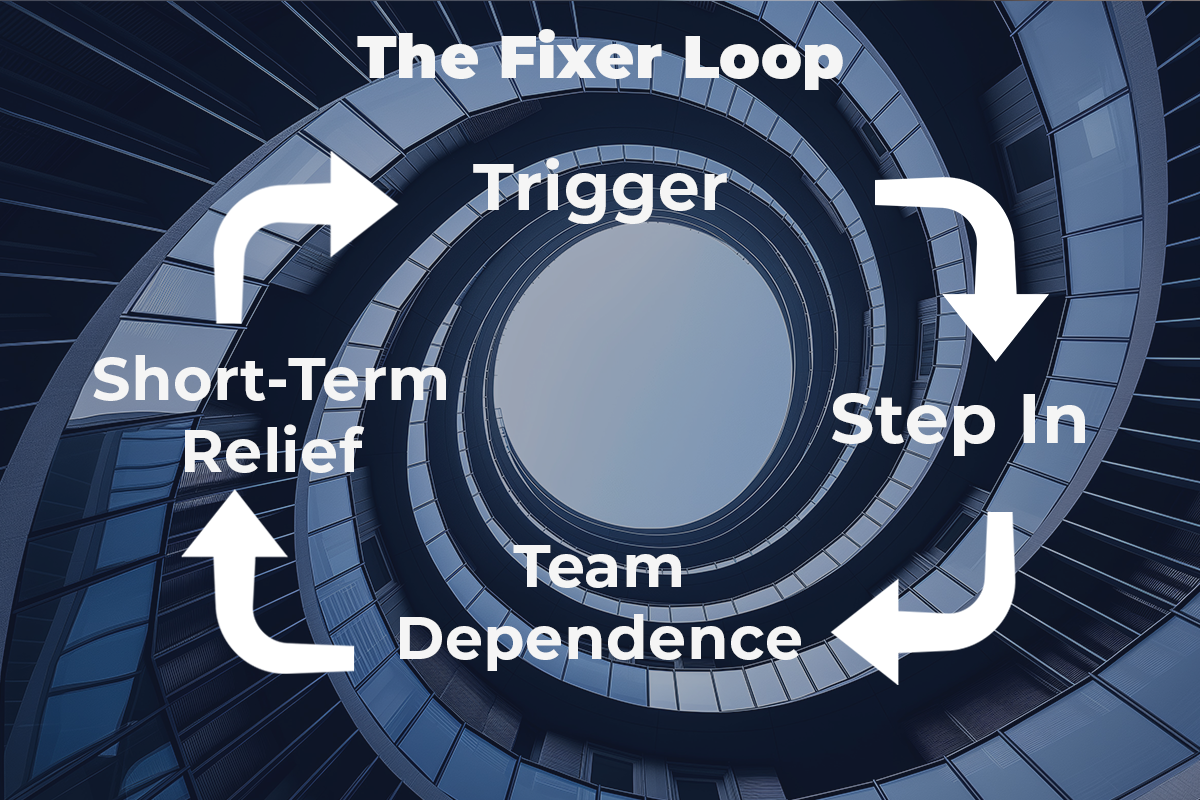
You step in to help. Your team steps back to stay safe. You step in again. They step back again. It's a pattern that just becomes normal over time.
And then you’re blinded sided with the constant requests for approval, meetings that become status updates instead of decisions, repeating yourself constantly because it’s faster, and nothing has any momentum until the moment you touch base.
It’s exhausting, it makes teams unsure about their work, and no one is truly proud of anything being done. That is the hidden cost of fixing: Your team learns dependence, and you carry the weight of every small decision being made.
The Coaching Swap: What to Do Instead
So, how do we step out of this reflex and towards something more practical?
The trick is to swap the mindset: You’re not trying to stop caring, you’re trying to stop carrying.
-
Name the outcome (not the task)Fixers give tasks, guides give outcomes.Try using this sentence as a template:“Winning looks like X by Y.”Now at first glance it seems simple, but what it implies has a profound effect.It’s setting clarity without the burden of control. It tells your team what matters… without telling them exactly how to do it.
-
Ask the ownership question (and pause)
Here’s a good way to change leadership in real-time.
Ask: “What’s your plan?” or “How would you approach it?”
Then complete the hardest part of this step: Pause.It’s not a way to be coy or mysterious about your intentions, the silence is creating space for ownership. If you fill every gap or complete every sentence, you train your team to wait. If you hold space, you train your team to think. -
Stay beside, not overCoaching leadership is like a good workout partner. You’re not lifting the weights for them, you’re spotting them to make sure they’re getting the reps in.Agree on a checkpoint.
Something like when they should check in and what they’ll have ready by that date.It’s clear, it sets expectations, and lets them own the outcome through each step.

Micro-Exercise: Break the Reflex in 7 Steps
If you’re serious about changing this habit, breaking the reflex can be done in as little as just 7 days.
Step 1
Step 2
Step 3
Step 4-6
Step 7
Step 1:
Identify your “step-in moment”
Where do you most often jump in?
Deadlines. Quality control. Customer issues. Conflict. Onboarding. Meetings.
Any of those are a great leaping point to start adjusting the expectation.
Step 2:
Pre-write your outcome sentence.
Before the moment happens, name the outcome and a time or standard it needs to meet. Bring it up to the team member owning the outcome and let them know.
Step 3:
Choose your ownership question
Pick one question to use every time.
Something like:
“What’s your plan?” or
“What do you want to own on this project?”
Help them find ownership themselves.
Step 4–6:
Practice the pause
When you feel the reflex hit, ask the question… and then pause for at least five seconds. Yes, it will feel awkward and that’s the point. That five seconds is where ownership starts to turn its gears.
Step 3:
Choose your ownership question
Participate in our online forum, share thoughts and ideas.
Step 7:
Reflect
Use this day to reflect and check in with yourself.
- Where did you step in out of habit rather than necessity?
- Where did you see teams excel when staying to the side?
- What was the hardest part of this and why was it difficult?
The Truth Leaders Need to Hear (Without Feeling Blamed)
You’re not wrong for how you learned to lead. We all learn those bad habits that pull us through earlier mistakes. You built what you built by being dependable.
But you can’t keep leading like everything is fragile, because your team stays fragile. The process stays fragile. And you stay tired and wonder why no one takes real ownership besides you.
The fixer reflex doesn’t make you a bad leader. It’s just proof you’ve outgrown the habits that built you up to the position you command now. And if you can trust yourself to make and fix your mistakes, being a good leader is letting your team do the same.
If you want a deeper structure for shifting this pattern across your leadership team, explore Workshops & Training or Coaching.
Tired of being the safety net?
If you’re ready to turn “fixing” into real ownership, let’s talk.
👉 Talk to us about Coaching
If you’re not sure whether you’re “helping” or overfunctioning,
👉Take the Leadership Reset Assessment.
If you’re not sure whether you’re “helping” or overfunctioning,
👉Take the Leadership Reset Assessment.

Write your awesome label here.
Tell Us About Your Event!
Steve Lowisz or Leah Nauseda will reach out directly!
Write your awesome label here.
Tell Us What Date You Are Requesting
Upon receipt of your request, Leah Nauseda or Steve Lowisz will reach out to discuss.
Work With Jason Lioy
Provide your information below and a member of our team will reach out within 24 hours.
Write your awesome label here.
Tell Us About Your Bank Event!
Steve Lowisz or Leah Nauseda will reach out directly!
Write your awesome label here.
Tell Us About Your Assocation!
Steve Lowisz or Leah Nauseda will reach out directly!